Accidental Collecting
People collect things for many different reasons. Talking to fellow collectors feels like a dialogue of one upmanship most times, because it’s tough for me to fathom that a person could know the specificity of an artifact from a past time. I’m impressed by the memory banks of fellow specialists. Or maybe it’s envy knowing they have access to something inaccessible, something that does not exist anymore, thus creating cultural capital and the need to want. For a vintage t-shirt, I admit, I often think about how one was able to find a rare piece. I’m also that person scouring eBay in hopes that that one t-shirt I threw away might have ended up on some seller’s listing.
This is how I felt watching Kevin Imamura at Nike SB share his t-shirt collection for TransWorld SKATEboarding’s “SkateHoarders” series (3:08-8:53). While the audience watches him go through his collection, he unfolds each t-shirt and explains their own acquisition history – a mixture of personal and professional history. This isn’t limited to just his t-shirts, but also includes his zine, deck, and ephemera collection. The same could be said about Brain Dead’s Isolated Community Zine. In “Collection: Marvel Trading Post” Justin Siow introduces the zine section with a historical note on his collection of Marvel t-shirts, stating that he doesn’t consider himself a “collector” (Siow, 2020).
I couldn’t help but feel similarities with these examples of personal collections. This approach is a concept of “accidental collecting”, which is touched upon by Elissa MacDonald for aMUSine. I think this characteristic of the personal archive directly contrasts the appraisal process of intentionally preserving something for the sake of history. Sometimes we just collect things without realizing it. There are no external stakeholders beyond our own selves. The mission statement is our tender memories. Perhaps it touches upon oral history as well. A reference, logo, or character may be so obscure it needs a little bit of explanation on why its existence on or as a t-shirt is important.
Some “Vintage” T-Shirts
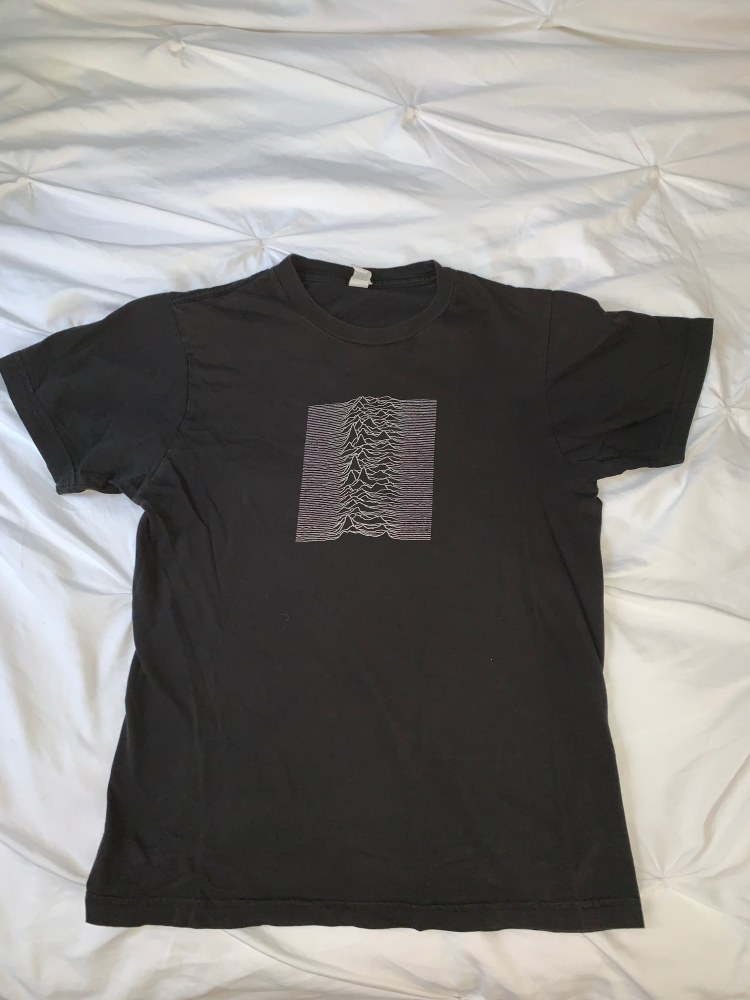
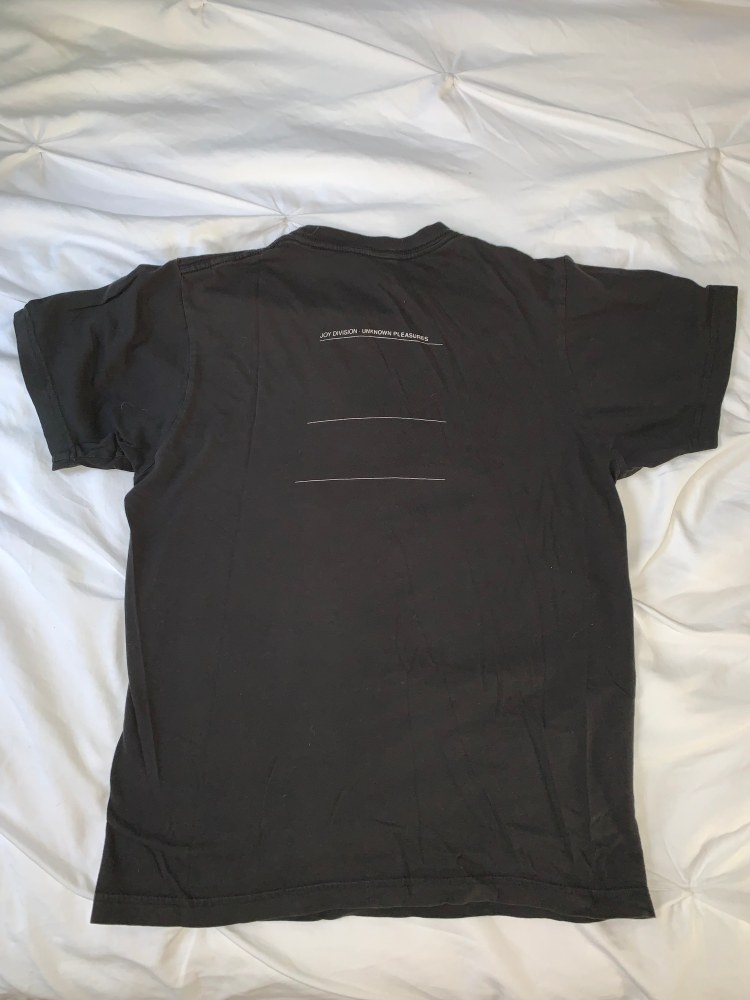

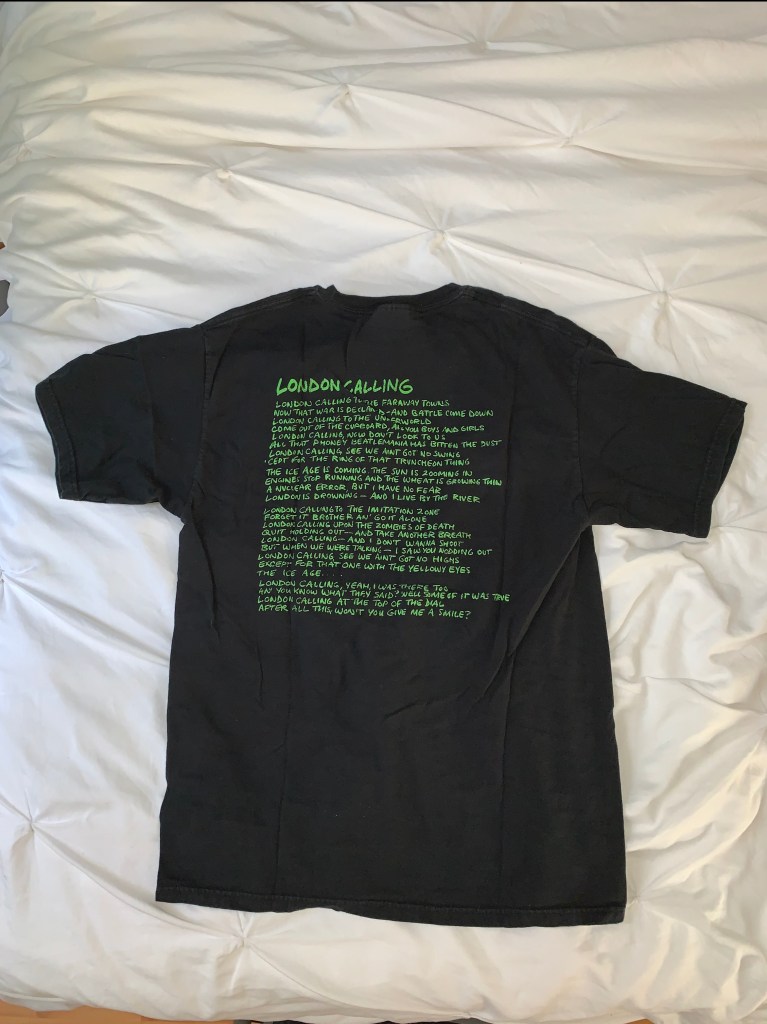
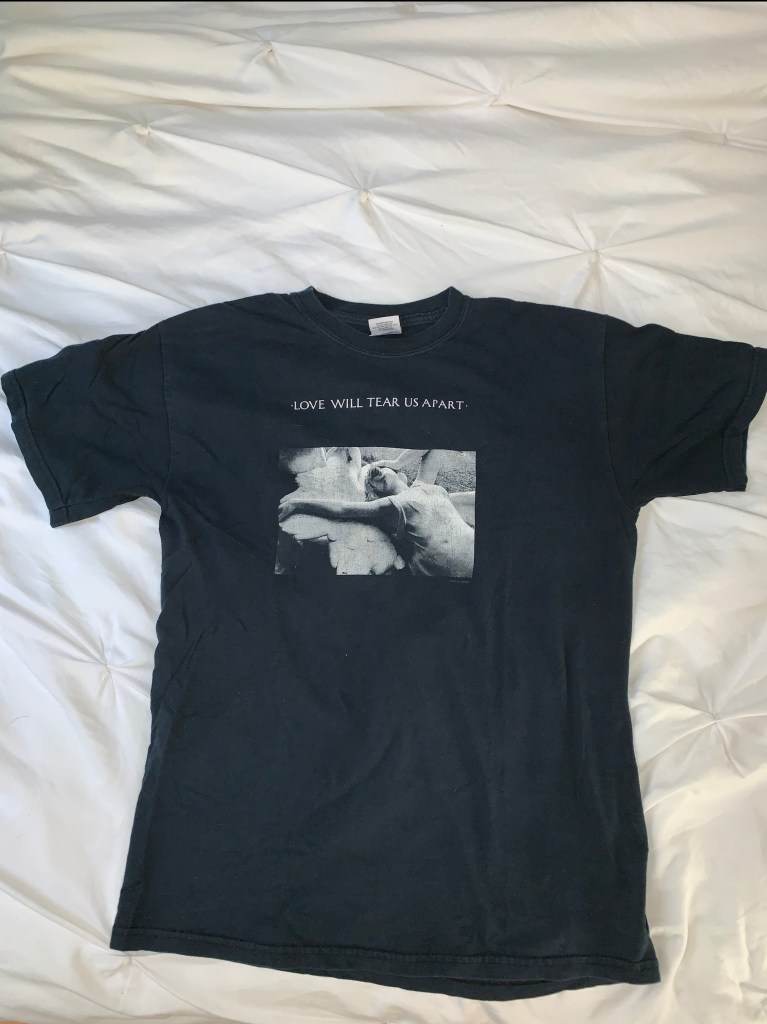

Without bogging down the details of theory, maybe I should start explaining why I bought these shirts. Here is my vintage t-shirt collection, a few pieces I kept over the years.
Wu-Tang Logo (2006), Slide 9
This t-shirt is the oldest piece in my collection. There’s no doubt about it, because I remember ordering this on CCS some years ago. I lived in Naples, Italy during that time, and it was known for packages to take weeks to get to a military FPO AE address. This shirt existed at the height of my obsession with 90s hip hop, a sort of counter attitude to the bling era rap that was coming out. Surely, it was foolish to think otherwise, but my mind was still stuck in 1997 when I first remember seeing the Wu-Tang Clan take formation across the television screen.
I believe my parents still have the VHS that had that music video, which was part of a compilation of music videos recorded by my sister and brother. As I wore this shirt in the hallways, I received head nods from the older kids in school. My friends threw up their W’s in the air, all proclaiming that “Wu-Tang Clan Ain’t Nothing to Fuck With.”
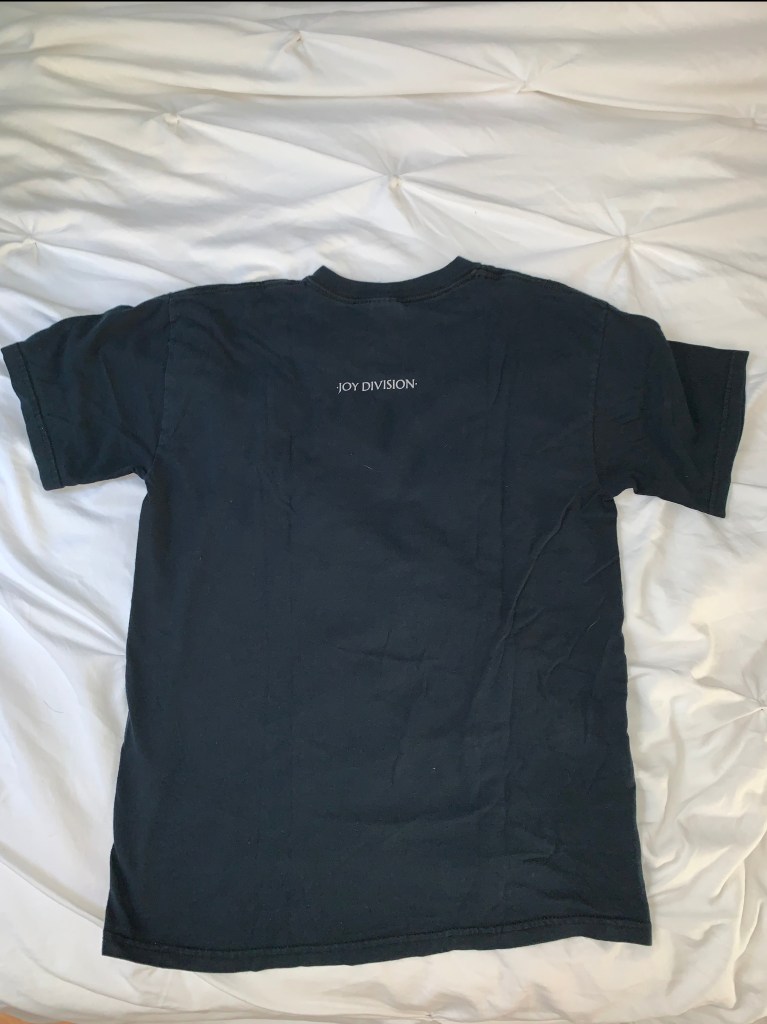
Joy Division “Unknown Pleasures,” “Love Will Tear Us Apart” (2009), Slides 1, 2, 5, 6
I remember the first time hearing about Joy Division because of an older friend from when I lived in Virginia Beach in 2007. He sent me the song “Love Will Tear Us Apart” on AIM, and he believed it was the band’s most symbolic work. He failed to mention that they’re historically known for their depressive music. Years later when I lived in Ketchikan, Alaska, I bought these t-shirts because Tom from 500 Days of Summer made them look cool. In other words, I was in the process of reinventing my wardrobe for the umpteenth time. This is a case of wanting to participate in conspicuous consumption look cool.
Wearing the shirts also meant I was conscious of the fact that people would start asking me about what the t-shirts even meant. Living in small town America gave plenty of opportunities into music snobs in their respective corners. I deep dived into J.D.’s catalog. I memorized Ian Curtis’ epilepsy dance. I wore only black for 5 days a week. What was wonderful about shirts like these is that it challenged me to really know a band’s history, but also the unfortunate legacy of its leader. I mourn for the loss of a missing piece from this trifecta, a white “Closer” shirt, which was Ian Curtis’ last album with the band.
The Clash “London Calling” (2007), Slide 3, 4
Some kid named Tim (I don’t recall his last name) had this shirt before me. I respected the fact that people around school knew him for this t-shirt. I was still in Alaska, but I went through a punk phase where I thought The Clash represented. My entry point into this band was when I used to sit alone in the school library during lunch. I was still a new kid, and for some reason the first song I decided to listen to was “White Riot.” It was a strange song at that age, because I was still unaware of my racial awareness as a Filipino teenager in a predominately white town. Yet, I could respect Joe Strummer’s reasoning to write the song to exhort “young white working-class Brits to be as outraged and proactive as their black counterparts in the face of government oppression” (Buskin, 2013)
Enter “London Calling.” I specifically recall getting in trouble for not interacting with my cohorts on a scholarship trip to D.C. because I chose to listen to “Lost in the Supermarket” instead of talk to them about what they did or where they were from. The record helped me to give less of a shit. One day when I was at school, I wore the shirt. My friend turned to me and asked, “Doesn’t Tim have that shirt?”
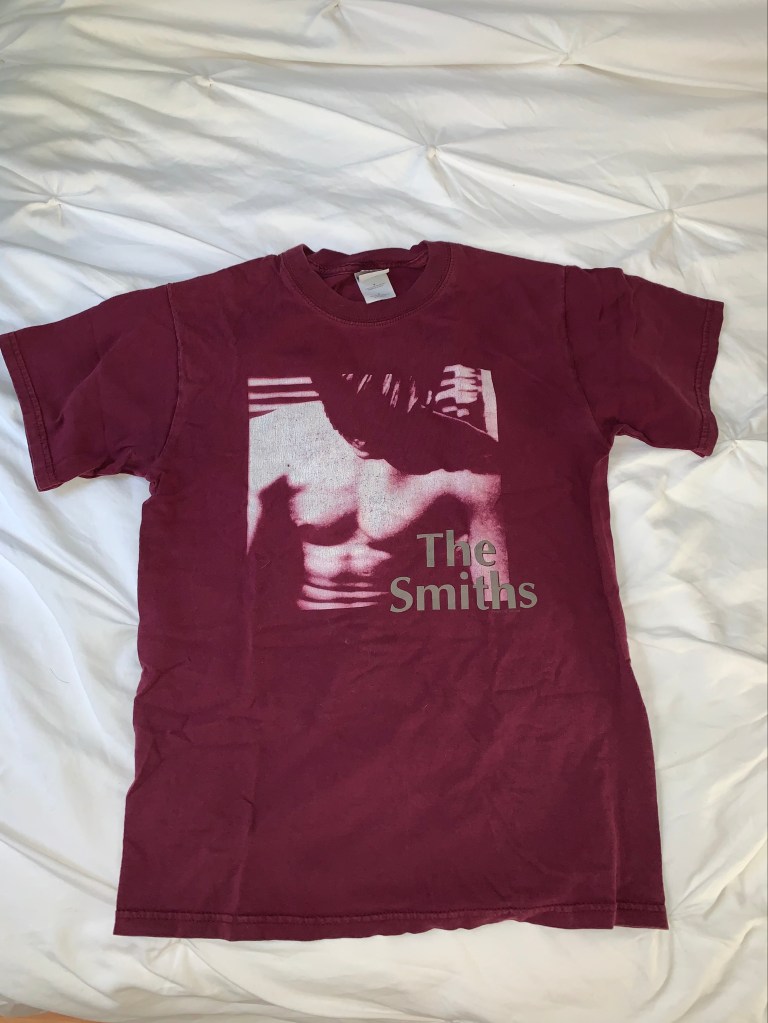
The Smiths “The Smiths” (2013), Slide 7
It’s hard to call this one part of the accidental collection, but I’ll qualify it based on the fact that I didn’t think I would even get this shirt. The Smiths have a direct relation to those Alaska years. Something about rainy days attracts teenaged blues to sad British rock like clockwork. In fact, the year before my parents had finally moved out of there after living there for close to 7 years. Their new assignment was in Yongsan Air Force Base in Seoul. I tagged along for a leap year, hiding away in some high rise, and listening to the quiet hum of the city for many sleepless nights.
Much like most leap years filled with soul searching, I browsed the internet for random things. Hopping on eBay, I searched for Smiths stuff. When I found the listing for the t-shirt, I laughed at the possibility that I could get the shirt, because I knew how popular The Smiths were. Self Titled has such a bon vivant that makes The Smiths unapologetically themselves. I placed my bid either way, and I went along my day. Fast forward to the late afternoon, I received an email telling me that I won the auction. A whopping $12 and two weeks later when it arrived, I joined Johnny and Morrissey on stage in my mind.
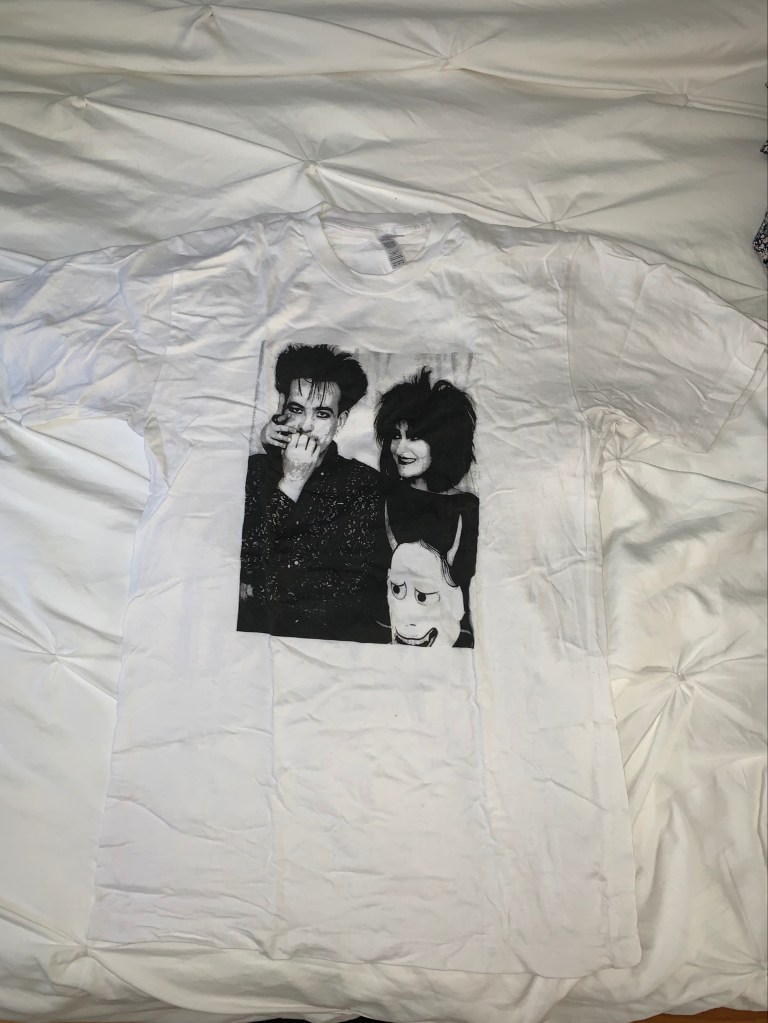
Robert and Siouxsie (2019), Slide 8
This is the most recent acquisition. Robert Smith and Siouxsie Sioux have always been relevant in the discussion of most important listens for me, but I have to admit I gravitated toward the Cure and the Banshees at a later age. I don’t think I had the emotional maturity to understand what either were doing with their music. Much like the J.D. acquisitions, I delved into both of their discographies to get a sense of their music beyond singles I had spent years playing in the background during hazy nights. The slow crawl of “Jigsaw Feeling” by Siouxsie and the Banshees had the confidence of a thousand suns while “Strange Attraction” by The Cure reminded me that Robert Smith could be coy and playful underneath all the dark glam.
The great part about this shirt is that a recreation by Jesse Pearson who runs Apology Magazine. The story about loss is reminiscent to the reasons we collect.
I was there . . .
Vintage t-shirts are pretty cool – but kind of divisive. For the person wearing the t-shirt, it signifies a badge that says “I was there.” Or not. Maybe you just like the thing (band, television show, or individual) the t-shirt is referencing. When confronting cultural gatekeepers, the vintage t-shirt functions as an invitation to the unwanted appraisal process in the form of questions veiled as judgments. “What’s your favorite album?” “Where did you get that shirt?” “Were you even alive during that time?” I’m not one to answer those questions because oftentimes it leaves the person asking questions unsatisfied – especially if it’s an answer they don’t want to hear. In fact, I’m more inclined to decline to answer because it feels a lot like a familiar question: “Where are you from?” If you like wearing a t-shirt with some sort of reference to something that you like, that’s enough.
Who am I to judge and be exclusionary?
But since you might be asking why the need for this piece, it is to really try to answer the question of cool. I think that this discussion of a vintage t-shirt’s cultural importance enters the sphere of appraisal and why we collect. What I am willing to proclaim is that a vintage t-shirt, to me, is an old t-shirt you threw once too many times into the washer. Perhaps on a more personal level, it’s an artifact that signifies the pasture of time and where you were at a specific moment in life. They are heroic capes. Or bad memories. If anything, they survived time. Or maybe they helped you survive. They are often crammed in the corner of your dresser or folded nicely and placed away in a hidden corner of your closet. And if you are lucky, you’re still able to wear it.
 MENU
MENU 
Leave a comment